Thursday, 12 August 2010

Compassionate City - Gandhigiri by City Police


Police in the City of Kozhikode in Kerala were flooded by complaints of people who lost their motor bikes over the last few months. Many had also lost gold, computers and mobile phones. The Police department was in for surprise, when they arrested more than fifty nine teenagers who were from lower middle class families and some of whom who were as young as 13! What was even more interesting was that many of them were selling it for silly amounts of Rs 3,000.

Kozhikode City Police says, “
Police recovered 15 bikes and seven personal computers stolen by the juvenile group from different locations. Besides, spare parts worth Rs 1 lakh was also recovered by the police. The teenagers used to steal new motorbikes with prices ranging Rs 40,000 to Rs 50,000 and put them up for sale at cheap rates ranging from Rs 3,000 to Rs 5,000 to their friends. Many of the juveniles belonged to low-income groups and broken families, but the buyers were from middle-class families. The culprits were utilizing the money received through theft for enjoining costly food, dress and mobile phones. Police will carry out further investigation and are expecting to recover more material evidences”

If the police were to follow regular procedures, they would be taken through routine course of questioning, lock-ups and year-long trials. In a typical loop of social branding as criminals, there is a hardly a way for any of them to be part of the main stream social life. Instead, Police Commissioner P.Vijayan who is credited for starting many new innovative initiatives in social policing including Student Police Cadet Project has turned a new leaf in the history of Kerala Police.

Today saw the most unique intervention of police to explore the possibilities of bringing these arrested youngsters to the mainstream and hence avoiding the near sure destiny of bring criminals of the future. Engaging the likes of palliative care movement (Institute of Palliative Medicine), few City Rotary Clubs and IMHANS (Institute of Mental Health and Neuro Sciences) along with a group of socially active citizens, the City Police is attempting to bring the youngsters back into main-stream with social acceptability.

Dr.Jairam Ramakrishnan, consultant Psychiatrist from UK also has been pitched in to provide expert service to the youngsters. Dr. Suresh Kumar, founder director of Institute of Palliative Medicine, popularly known as “poor men’s Doctor” considers such initiatives with public private participation is a beginning to build up a “compassionate city”.

A one-room initiative that was started as a ‘pain clinic’ fifteen years ago in an anesthetist's dressing room in Kozhikode Medical College for bringing in relief to terminally ill patients has now grown into a movement comprising more than 25000 trained volunteers. Self-sustainable 300 palliative centres in Kerala is now spear-heading a social movement, not just restricted to palliative care. No wonder that such a movement is approached by various stake holders to take larger roles in the society.

Follow this space for more on ‘compassionate city project’
.

Wednesday, 11 August 2010

Marriage proposal at 4200 MSL


'Make no mistake' leader of the group seems to be convincing our driver

We were on our way after a volley ball game with young lamas of the monastery in the picturesque village of Komic, when we came across some women who came and blocked our way. Women in Spiti Valley are quite social and confident. Since we have heard several stories about their empowerment we were more than curious to know why they would block our way.


These women refused to let our driver go. They even sat on the bonnet for a while!

We were driving from Kaza to Komic and back en-route to Langza. The Komic at an altitude above 4000 MSL is amongst one of the high altitude villages in the Himalayas.

Initially we couldn't figure out what was happening. All we could notice was that the women, especially the older ones were quite happy about blocking the road and talking to our young driver. There was also a young girl who was shying away when we looked at her, but 'making strong' statements to the driver.


volley ball with lamas in one of the highest villages in the world.

Even after ten minutes, when we realised that they had no intention to let us pass by, we got curious and asked our driver if every thing was okay! He blushed! Once again we weren't sure if we read the expression on his face correctly. By this time two women were already sitting on the bonnet while other engaged in conversation with the boy. It looked more like a cajoling towards the end, but we were totally lost on what exactly was going around.

After half an hour, our driver tried to move the vehicle slightly which was vehemently opposed by the group. They refused to let us go! Later in the afternoon when we managed to pass them, our driver told us that the women were trying to convince him to get married to a girl in their village! No wonder he was blushing. Apparently a proposal had come to him couple of months ago and he was not ready to get married at 23, and the women refuse to accept that. So every time his vehicle passes through the village with travellers, he is under siege! Poor thing.

Wednesday, 4 August 2010

Lucky - the musician of Kaza


The best thing to do after arriving in Kaza for the first day is to-do-nothing. Especially for those coming from the plains, acclimatisation is the key to survival in high altitude regions like Spiti Valley. For those who are visting to have a ‘look’ at Spiti Valley, they lose more than 4-5 days just to reach and exit. As there is so much to see and do in the entire valley it is gross injustice to plan a holiday for a week. But that’s exactly what we ended up doing in the name of a ‘working’ holiday!

Along with my fascination for local food, another adventure I get into in Indian destinations is to try out the traditional head massages. Except for the last bit of cracking of neck, I let them do everything in a way they want to do. Every time they bring in their palm closer to my neck I ward them off as evil. The idea of a broken neck scares me away from these guys.

After swallowing the bad taste of ‘croissant and cinnamon rolls’ from the ‘German bakery’, I was looking for an avenue to entertain myself. For all the ‘almost-broken-bones’ after the previous days twelve hour journey from Manali, I didn’t want a ridiculously priced breakfast croissant ( not to say of its taste!) to spoil my mood. It was then I noticed ‘Lucky’ hair dressing salon right opposite to the eatery. Lucky, a fashionable (if your fashion taste belongs to 70’s) young man who comes from the plains, spends five months of ‘season’ in Kaza and the remaining time in his village like all business people who work in Spiti Valley.

Lucky has a way with your head! Moving his fingers in a unique way, he is not the typical road-side barber who ‘champissage’ you by drumming his way with your head. He respects the person in front of him, he feel their energy levels and rhythmically move his fingers, palm and fist in such a fascinating way on your head, neck and face. If you observe him carefully, you can see how he treats each customer differently. Like a bass player he picks out his own notes that fit the chords like a ‘walking bass line‘.

For me Lucky was one of the best barbers I have come across during my travel in the country. If you ever visit the small town of Kaza, don’t miss out on the ‘Lucky’ experience. This humble and warm person can make a difference to your Spiti experiences. Lucky could be the improvised soloist playing his jazz in the cold desert of Spiti. If one still feel the rhythmic massage on tired neck even after a week’s time, that’s when you realize that the massage wasn’t just a jumbled up bunch of notes, but certainly a magician who can multi-task as a drummer, soloist and chord-player!

And to the customer who loudly commented that she felt her head was put in a washing machine for a while, well, all I can say is that it’s quite ‘un-Lucky…’

To the middle land


en-route to Kunzum pass

Altitude sickness, head-aches, nausea are familiar even for seasoned travelers by the time they reach Kunzum pass. It is a routine for the tourists to stop over at the Ghonpa at Kunzum pass on their way to Spiti Valley. For the locals, it’s part of their Buddhist rituals to pay respect at the Ghonpa that is visible once you start climbing from the valley. For the un-initiated, the rituals look more like a thanks-giving for offering safe passage on the wretched, narrow roads that’s been chiseled through the mountain ranges . For the tourists, this is the perfect gateway to Spiti Valley, where they also take a break and stretch their knackered-body after several hours of tideous journey from places like Manali.


road to no-where? ice formation from last winter on the 'road'
'

Soon after crossing the village of Rangrik and the extremely ugly looking hotel called Spiti Sarai (why on the earth do they ever want to build such a building when local architecture is so beautiful and efficient for their climate?. It shocks even more when you know that it’s been built by a local to ‘exploit’ the new opportunities offered by tourism), signs of the colourful Kaza are visible. From a larger hamlet consisting of multi-coloured buildings, green patches of farm land; the sight gives the idea of a prosperous small town from a distance. Tenzin, our ever-smiling driver from a village near Tabo says,” Kaza is the capital of Spiti Valley and all the administrative offices are based out of here”.


Rare breed of Spitian Chamurthi horses known for its unique gallops. Locals says Raiders like Genkis Khan used Spitian horses as the riders hardly felt tired on them.

The nearer we reach the beauty of small traditional villages and landscape transforms into ugly concrete buildings built by PWD and migrant business people. Traditional roofs have given away to metal sheets painted in green, mud walls have given away to cement plastered bricks, energy efficient ceilings have turned into ugly looking make-shift roofs.

Comparatively new to the tourism circuit, Kaza is now a base for most back-papers to move out to many attractions including Kee, Kibber, Tabo, Dhankar, and it’s in-numerous trekking routes and camp-sights. Sweeping our way through the confusing combination of drainage and tiny springs of fresh water, we checked into a newly built hotel Le Karza built by a Spitian career-civil-service officer. Of course, no one is expecting French ambiance and levels of comfort in a hotel in Kaza because it has a prefix of “Le”. Though we didn’t come to Spiti valley looking for comforts, we immersed ourselves to the comfort of our bed with clean linen and cushions. The gorgeous Mountain View from the balcony and bathroom reminded of better things to come in the coming weeks.


Our driver Tenzin was carrying a "leaf" from Manali for a fellow driver, whose vehicle was stranded near Kunzum pass for past 48 hours.

Monday, 19 July 2010

Manali: cleanliness and local cuisine


It’s been couple of years since I had been to Manali. First thing that came to my mind last time was the keenness in which shop keepers were giving away things in paper bags and not in plastic bags as you would see in many other parts of the country. The idea is en-grained well into the visitors as well as they are enjoying this way of transaction. So today, when we went out shopping in the evening, it was a pleasure to see the same practice continuing. Though we didn’t get much time to move around the town, whatever we saw looked clean, (compared to an average Indian town), there seems to a visible Governance and people’s participation. If Manali can do this, why not other towns in India?

However, what was missing was the local food. My practice of religiously tasting local food came under tremendous tension as we couldn’t find a single ‘local’ eatery even after searching in about 20 restaurants in the vicinity of bus station and market. Most of them had menu describing Punjabi, South Indian, Gujarati, Bengali and Italian cuisines. Some restaurants had menu printed out in Hebrew as well; clearly showing the pattern of visitors to the hill station. Why would I want to come to Himachal Pradesh and have a Masala Dosai? Wouldn’t I rather have my Chicken Tikka Masala elsewhere? As for an Italian pizza, this isn’t where I want to explore.

Though it was raining cats and dogs, we didn’t want to give up looking for local eatery. Finally we found David’s café, a tiny eatery on Hadimba temple road. Run by a family, they basically serve what they eat. Though we ended up eating chappathi and zubji for the evening, Sita , the proprietress of the eatery told me that she still continues to cook ‘Maahni’ and ‘Madra’. May be on the way back to Delhi, we should stop by to check her culinary skills.

When every tourist destinations look like the same, and the food taste the same, wouldn't people just stop travelling?

Friday, 16 July 2010

Dilli mein sub chaltha hein!

It’s not that every day in your life that a cab driver would ask you to drive the car while he enjoys his can of Kingfisher beer! The night before yesterday, I ended up driving a cab in the rain from Karolbagh to Delhi Cantonment. It was not just the trust the driver showed in me, but the ease in which I took charge of the car for an hour-long journey that surprised me the most. Spiced with stories of the young man who introduced himself as Amit, I drove through streets of Delhi, scared of being hit by vehicles and pedestrians and cows from all sides.

We had noticed that Amit was quite a special person when we went to Gopinath bazaar looking for a taxi that will ‘ferry us’ through the water-logged roads to Karol Bagh. When rest of the taxi drivers refused to come, Amit volunteered and ‘fixed’ 400 Rs for the return trip and while starting the cab made a statement;”can’t stand those guys who don’t take their duty seriously’. As we were busy with some discussions, we didn’t give much thought to his statements.

However with the steering wheel in hand, I had not much option than to hear out Amit. He showed me photographs of his wife, daughters, younger brother and shared with him his journey from being a martial artist, to a dancer and to being a driver. While sharing all this, he kept on giving me directions and couple of times even ‘corrected’ my driving style suggesting that I am driving like a ‘phoren’ person and probably too sophisticated for Delhi roads. Great.! All I was doing was to recheck that I was not driving on a one-way in opposite direction. Of course I was and he said, “Saab, ye Dilli hein, idhar sab chaltha hein”. Considering that there were policemen and traffic wardens present who didn't care about what we were doing, I had to believe what he told me. That, “this is Delhi and everything is alright here”.

If I had an option I would have drove around the whole night just to hear the stories and experiences of life that Amit was sharing with me. From the 18 girlfriends he had while being an instructor to them at driving schools, to the responsibility he finally took to look after his family, and his ability to speak 12 languages, ( at least he could speak smattering English, Tamil, Hindi, Marathi, Malayalam, Kannada and Telugu!), the stories seem to have come straight from his heart. There was no other way than to believe him, as it didn’t come across to me as a lie, or something he was trying to show to impress me. In any case I have no clue how he was trying to impress me by asking me to drive his taxi while he was enjoying his beer! How can I not mention that he was also a dancer at the Woogie Boogie?!

Once we were out of the maddening traffic, he commented that I am a ‘good driver’ ( he seems to have forgotten already how much I was struggling while he was ‘sheperding’ me through the traffic by moving inch by inch to ‘occupy’ any advantage we could get over others on the road!). The best part of the drive was when he asked me ‘How the ‘gaadi’ was?’. It was actually a good vehicle, and when I said I was enjoying driving it, he said, “99 ka hein! CNG, Mein bahuth pyar se chalatha hum!”. It was obvious that he was driving it with 'care and love'.

If everyone would do their job as passionately as Amit ( and of course, not handover the taxi for driving to their customers) and engage their guests with real life or spicy stories like this, I guess even a crowded Delhi traffic pass like a cool breeze! My only regret of this adventure is that I couldn’t get a photograph of Amit and his car!

May be this is the local interpreter The Blue Yonder has been looking for in Delhi!

Media responsibility on palliative care


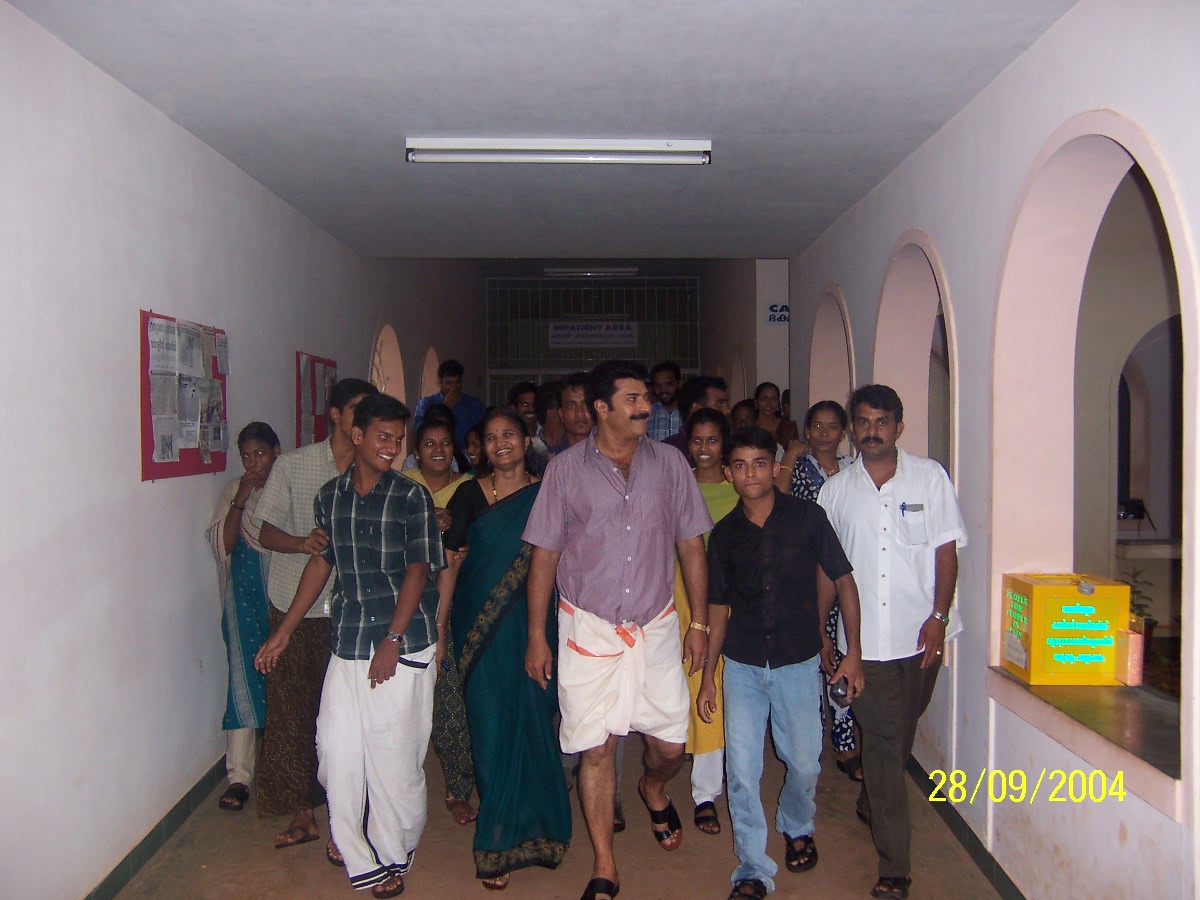
Photo:Malayalam movie actor Mammooty on his frequent visits to the palliative care clinics in Calicut

A report in today's Times of India screams 'India worst in end-of-life care'. The report rightly laments about the poor condition existing in the 'end of life care' and how India is lying at the bottom of 40 countries from which sample data has been collected. It's true that a newspaper should highlight such a sad state of affairs in a vastly growing economy like India. TOI reports, 'India doesn't just have a poor quality of life, as reflected in its poor human development index (HDI), it also has a particularly poor 'quality of death'.

However what is missing in the news report are some of the highly positive remarks in the original white paper published yesterday by Economist Intelligence Unit on issues surrounding end-of-life care. It says "Amid the lamentably poor access to palliative care across India, the southern state of Kerala stands out as a beacon of hope. While India ranks at the bottom of the Index in overall score, and performs badly on many indicators, Kerala, if measured on the same points, would buck the trend. With only 3% of India’s population, the tiny state provides two-thirds of India’s palliative care services. More over, the state has a formal palliative care policy in place (it is the only Indian state with such a policy)and its government provides funding for community-based care programmes. It was also one of the first of India’s states to relax narcotics regulations to permit use of morphine by palliative care providers. Kerala has also extended the definition of palliative care to include the long-term chronically ill and even the mentally incapacitated."

The report highlights the success story of palliative care movement in Kerala that uses holistic and unconventional approaches compared to institutionalised western approaches. What started in a dressing room of two anesthetists in Calicut Medical College is now the most unique approach to palliative care that is being replicated in countries like Bangladesh, Seychelles and even Switzerland.

While reporting on the sad state of affairs in India vigorously, Times of India could also have inspired many with the success story of palliative care movement in Kerala. With more than 250 self-funded palliative clinics and a massive volunteer base that crosses 20,000 trained volunteers who re-defined community participation in health sector, there are plenty of learning for many other Indian states.

This success story of palliative care movement has to be told mainly because the Government - Public participation (especially community involvement in fund raising and caring) is something that can be replicated in other parts of India. As Dr. Suresh Kumar, Director of Institute of Palliative Medicine says, “there are a lot of medical problems, but there are also a lot of
social, spiritual and financial issues—so anybody who has time to spare can, if properly trained, take care of these people,”.

Indians have heard enough of negative things about their country. It's time we celebrate success stories. Media has a role to play in it.

New Delhi


The first impression of Delhi more than a decade ago was the chilly January, smoggy city, unbelievable crowd on railway platforms (not to mention of those who all considered it as their literal spittoons), arrogant auto drivers, road rage of green line buses and filmy policemen. Introduction to a largely corrupt NGO sector completed the full circle of Delhi. The only positive thing other than some fantastic friends I made in Delhi looked like the small “KIT KAT’ eatery that served the best Paneer mutter masala and Bhurji in South Ex market!

This was soon after I moved from corporate to the development sector. Over the period of last ten years, occasionally I got introduced to some wonderful people ranging from politicians to bureaucrats, social entrepreneurs, activists, cultural stalwarts, writers and some page 3 personalities. From my first visit till now, Delhi has grown by couple of million people, increasingly choked roads, more stupid looking and inefficient policemen, a good metro that partially connects the city and less polluting vehicles that ply the choked roads.

Couple of weeks ago when I came to Delhi once again to launch some new initiatives, I was still weary of the city. Profusely cursing the sweltering heat, I went on praising the cool climes of Bangalore and wonderful Monsoon of Kerala. While listening to my rants on what I am doing in this City, some of my friends patiently reminded me that the easy way to handle any city is to accept it as it is and find my way around.

Two weeks in the city is bringing me closer to it and teaching me to look at the many positive sides it has. There might be a reason why 14 million people might be living in this city. Right?

Friday, 6 March 2009

Viking Laws


Came across these lines on a post card.

# 1 Be brave and aggressive.
Be direct.
Grab all opportunities. Use varying methods of attack.
Be versatile and agile.
Attack one target at a time.
Don't plan everything in detail.
Use top quality weapons.

# 2 Be prepared.
Keep weapons in good condition.
Keep in shape.
Find good battle comrades.
Agree on important points.
Choose one chief.

# 3 Be a good merchant.
Find out what the market needs.
Don't make promises that you can't keep.
Don't demand overpayment.
Arrange things so that you can return.

# 4 Keep the camp in order.
Keep things tidy and organized.
Arrange enjoyable activities which strengthen the group.
Make sure everyone does useful work.
Consult all members of the group for advice.
GP 2009, Oslo